
Tradexacademy
 Candlestick Patterns Course, Candlestick Patterns Course for Beginners, candlestick pattern training, best candlestick patterns course, Candlestick Pattern Online Course
 0 comment
 11 Aug, 2026
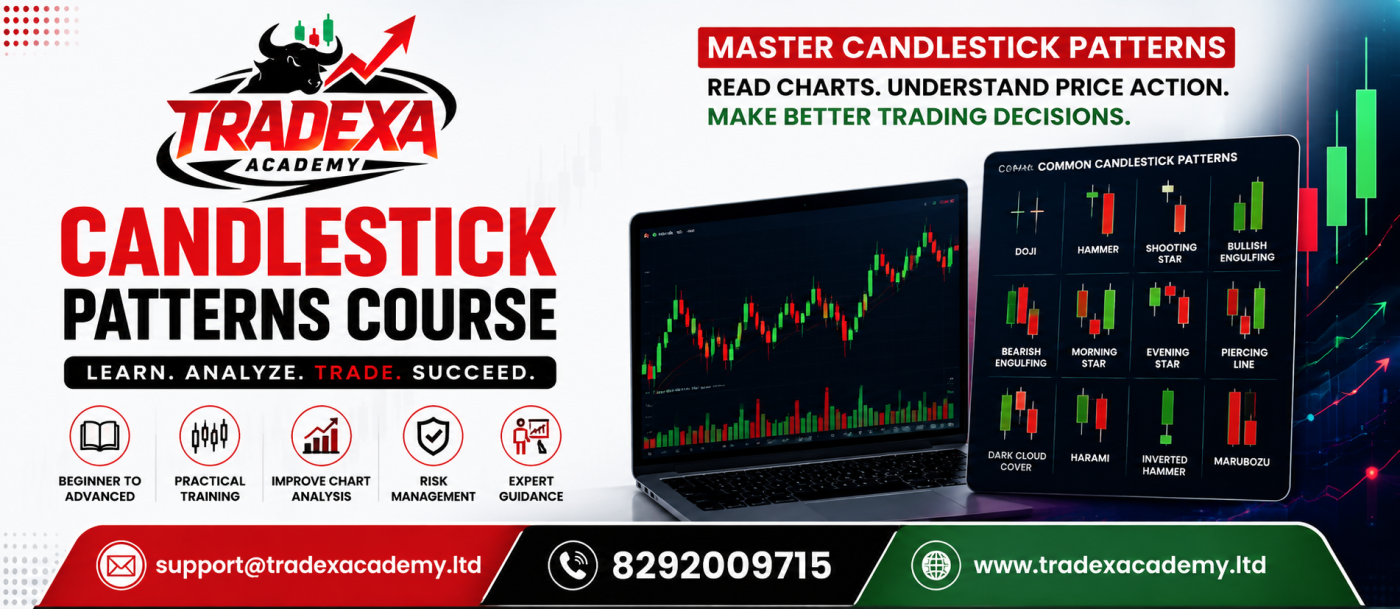
Understanding price movements plays an important role in stock market trading. Traders use different tools to study market behaviour, identify trends, and plan potential entries and exits. Candlestick patterns remain one of the most popular tools for reading price action.
A Candlestick Patterns Course can help beginners understand how candlesticks form, what different patterns indicate, and how traders can combine candlestick analysis with technical indicators and risk management.
Tradexa Academy provides structured trading education for learners who want to develop practical knowledge about technical analysis and financial markets. A well-planned Candlestick Patterns Course for Beginners can provide a strong foundation for anyone starting their technical analysis journey.
A candlestick represents the price movement of an asset during a specific time period. Each candlestick generally displays four important price points:
The relationship between these prices creates different candlestick shapes. Traders study these shapes to understand buying and selling pressure.
Candlestick patterns can appear as single-candle formations, two-candle formations, and multi-candle formations. Each pattern can provide information about market sentiment and possible price behaviour.
However, traders should not treat any single pattern as a guaranteed signal. Market conditions, volume, trend direction, support and resistance, and risk management also matter.
Candlestick analysis can make price charts easier to understand. Instead of looking only at numbers, traders can visually study price behaviour.
A structured candlestick pattern training program can help learners understand:
Learning these concepts can help traders develop a more systematic approach to chart analysis.
Beginners often struggle when they first open a trading chart. Multiple candles, indicators, price levels, and market movements can appear confusing.
A Candlestick Patterns Course for Beginners can simplify the learning process by introducing concepts step by step.
Students first learn the basic components of a candle. They understand the open, high, low, close, body, and wick.
Learners can study candles such as:
After learning individual candles, students can explore formations involving two or more candles.
Examples include:
Students can then study how these formations appear during different market conditions. This practical approach can help learners understand the difference between simply identifying a pattern and analysing it within market context.
A Doji forms when the opening and closing prices remain close together. It can indicate indecision between buyers and sellers.
A Hammer generally features a small body and a longer lower wick. It can appear after a decline and may indicate a potential shift in buying interest.
A Shooting Star has a small body with a longer upper wick. It can appear after an upward movement and may indicate selling pressure.
A Bullish Engulfing pattern involves a smaller bearish candle followed by a larger bullish candle that covers the previous candle's body. Traders may study this formation as a potential bullish reversal signal.
A Bearish Engulfing pattern occurs when a larger bearish candle follows a smaller bullish candle. Traders may analyse it as a possible indication of increasing selling pressure.
The Morning Star is a multi-candle formation that can appear near the end of a declining market movement. Traders often study it when searching for potential bullish reversal conditions.
The Evening Star can develop near the end of an upward movement and may signal increasing selling pressure.
People searching for the best candlestick patterns course should focus on learning quality rather than promotional claims.
A useful course should cover both theory and practical chart analysis.
Before choosing a program, consider:
A strong course should teach students how to analyse patterns within the broader market structure. Simply memorising candle names does not create effective trading knowledge.
A Candlestick Pattern Online Course provides flexible access to technical analysis education. Students can learn from home and organise their study schedule according to their availability.
Online learning can benefit:
Tradexa Academy can help learners build their technical analysis foundation through structured market education.
Online learning also allows students to revisit difficult concepts and practise chart-reading skills repeatedly.
Candlestick analysis goes beyond identifying shapes on a chart. Each candle reflects the interaction between buyers and sellers during a specific period.
For example, a long bullish candle can show strong buying activity during that period. A long upper wick can indicate that buyers pushed the price higher before sellers entered the market.
By studying these movements, traders can develop a better understanding of market psychology.
This approach can help learners ask useful questions:
These questions encourage analytical thinking rather than impulsive trading.
Candlestick patterns become more useful when traders analyse them alongside other technical tools.
Learners can combine candlestick analysis with:
For example, a bullish candlestick pattern near strong support may attract more attention than the same pattern appearing randomly in the middle of a trend.
This is why practical candlestick pattern training should teach context, confirmation, and risk management alongside pattern recognition.
Candlestick patterns cannot predict market movements with certainty. Every trading strategy carries risk.
A responsible learning program should teach students how to manage potential losses.
Important risk management concepts include:
Traders should never risk money simply because a candlestick pattern appears on a chart.
Tradexa Academy focuses on financial market education and practical trading knowledge. Learners can build their understanding of technical analysis through structured lessons and market-focused concepts.
The academy's learning approach can help students understand:
For beginners, structured education can provide a clearer path toward understanding financial markets.
A candlestick course can suit learners at different stages.
Beginners: Learn the fundamentals of candles and price action.
Traders: Improve chart-reading and technical analysis skills.
Investors: Develop additional tools for analysing market trends.
Working Professionals: Learn through flexible online education.
Students: Build foundational financial market knowledge.
Candlestick patterns can provide valuable insight into price action and market sentiment. However, successful market analysis requires more than memorising pattern names.
A comprehensive Candlestick Patterns Course can help learners understand candle structures, reversal formations, continuation patterns, market psychology, technical indicators, and risk management.
Tradexa Academy provides a structured learning environment for individuals who want to develop practical trading knowledge.
Start with the basics, practise pattern identification, analyse real charts, and gradually develop a disciplined technical analysis approach.
Educational Note: Candlestick patterns do not guarantee profitable trades. Financial markets involve risk. Always conduct proper research and apply suitable risk management before making trading decisions.
A Candlestick Patterns Course teaches learners how to read candlestick charts, identify common patterns, understand market psychology, and apply candlestick analysis alongside technical analysis tools.
Yes. A beginner-focused course can introduce candlestick structure, basic patterns, chart reading, market trends, and risk management in a progressive learning format.
Candlestick pattern training can teach candle structures, bullish and bearish patterns, reversal formations, continuation patterns, price action, market psychology, chart analysis, and risk management.
Common patterns include Doji, Hammer, Shooting Star, Bullish Engulfing, Bearish Engulfing, Morning Star, Evening Star, Harami, and Marubozu.
Yes. A Candlestick Pattern Online Course provides flexible learning and can help students study technical analysis from their preferred location.
Look for a course that provides a comprehensive curriculum, practical chart examples, pattern identification, technical analysis, market psychology, risk management, and structured learning support.
No. Candlestick patterns provide analytical information but cannot guarantee trading profits. Market conditions can change quickly, so traders should use confirmation and proper risk management.
Candlestick patterns can help beginners understand price action and buying and selling pressure. They can also provide a foundation for further technical analysis learning.


Tradexacademy
0 comment